Kids are likely using AI more – and starting earlier – than parents realize.
Research reveals that 63% of parents don’t know their teen is using AI, and nearly half of parents (49%) have not discussed generative AI with their teens [1].
63% of parents don’t know their teen is using AI
Product decisions at Bud AI are designed around strengthening trust between parents and their kids – because we know this relationship is foundational to true AI safety. Kids of parents who are personally familiar with AI are much more likely to engage in safe practices such as verifying AI’s accuracy (53% vs. those whose parents haven’t used AI) [1]. When you regularly have nuanced conversations, kids learn to use AI safely and skillfully.
Start with Support, Train Towards Agency
When AI democratizes basic knowledge, the kids who thrive will be high-agency critical thinkers.
Agency refers to the capacity to shape life rather than simply remaining a passenger. Psychologists view agency as a “developmental capacity” because it is not fixed, but can be actively built, especially during the key developmental phases of childhood and adolescence.
Nurturing agency requires balancing support with independence: enough scaffolding that kids learn good judgment, enough autonomy that they can practice using it.
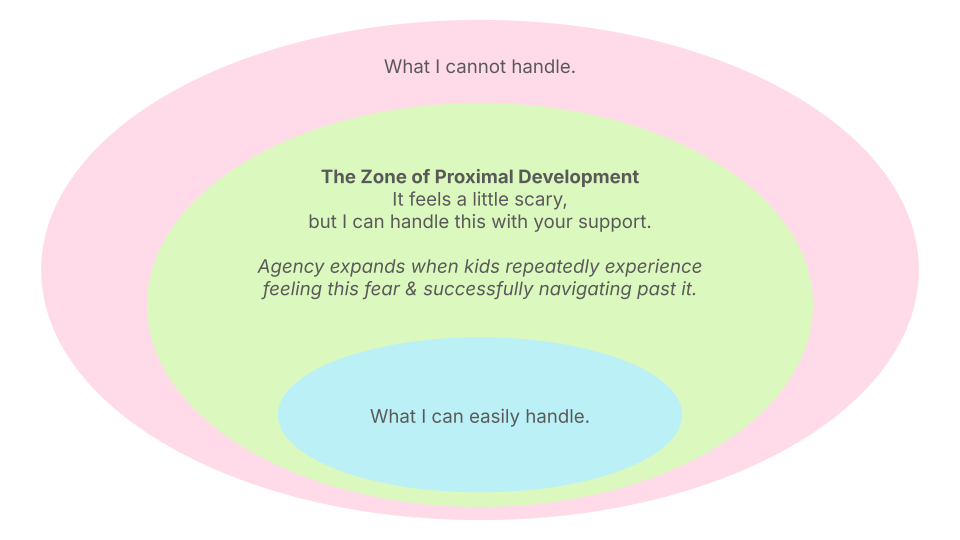
Kids learn most within the zone of proximal development – when they are given challenges just beyond what they can do independently as well as a “more knowledgeable other” (parent, teacher) who is there to provide scaffolding.
The zone of proximal development should feel just a little bit scary. When you hand your child more autonomy, you want them to feel “Whoa, you just gave me a lot of power. Can I handle it? I hope I can. If I get too scared, I know you’re still close enough to help.”
Agency expands when kids repeatedly experience feeling this fear and successfully navigating past it.
Build a High Trust, No-Shame Relationship
For most of human history, shame was a common parenting tool. Only in the past 40 years have we learned that it’s actually toxic.
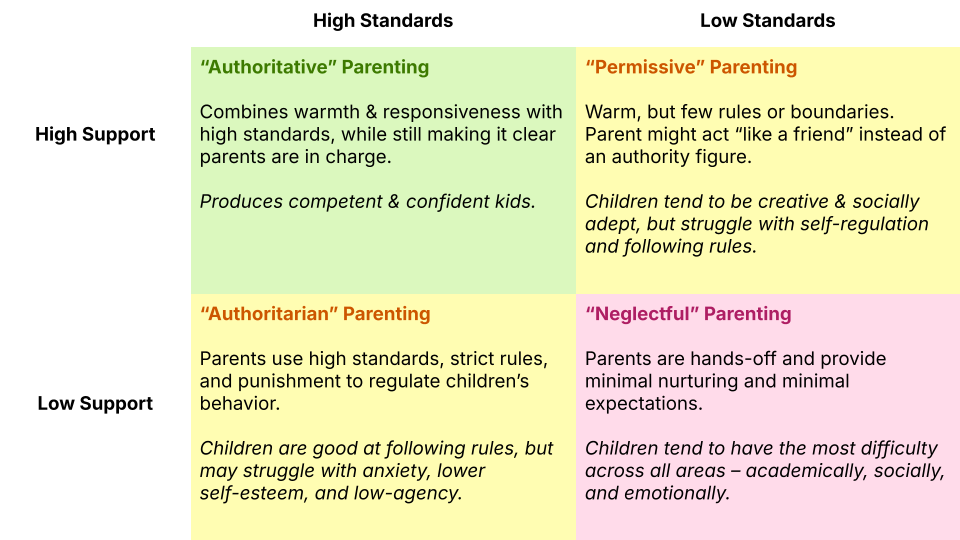
In the 1980s, psychologists Baumrind, Maccoby, and Martin defined four parenting styles based on two dimensions: standards (high/low) and support (high/low). They found that Authoritative Parenting – combining high standards with high support – produced the most competent, confident children. In contrast, the older model of Authoritarian Parenting – high standards but low support, relying on shame and control – produced anxious, less competent kids [2,3].
Shame is particularly tricky for kids because they can’t yet distinguish between “I did something wrong” versus “I am fundamentally wrong.” Shame collapses agency and instead triggers behaviors like defensiveness, withdrawal, self-criticism, and secrecy.
Instead of shame, building trust is a more effective way to keep your child safe in the long run. Trust has three key ingredients:
- Care: You communicate warmth and unconditional positive regard. Your child knows you’ll be there for them, even if they mess up.
- Communication: You clearly communicate your rules and reasoning while taking time to understand your child’s perspective.
- Consistency: You follow through consistently on what you say. If you say mistakes are learning opportunities, you treat them that way.
In most cases, kids should know how you are monitoring their AI usage – no secret surveillance. Transparency tends to strengthen trust while snooping weakens it.
Research on parent-child relationships shows that trust-based knowledge is more effective than surveillance-based knowledge. Psychologists Stattin and Kerr found that adolescents who voluntarily disclosed information to their parents had better outcomes than those whose parents relied on strict monitoring and control [4]. While their research focused on peer relationships and social behaviors, the principle extends to AI use: when kids fear judgment or harsh consequences, they simply get better at hiding.
When they trust you enough to come to you with questions or mistakes, you can guide them to become the kind of kids who thrive in an AI-shaped world.
References
[1] Common Sense Media (2024). The Dawn of the AI Era: Teens, Parents, and the Adoption of Generative AI at Home and School. Available at: https://www.commonsensemedia.org/sites/default/files/research/report/2024-the-dawn-of-the-ai-era_final-release-for-web.pdf
[2] Baumrind, D. (1966). Effects of authoritative parental control on child behavior. Child Development, 37(4), 887-907.
[3] Maccoby, E. E., & Martin, J. A. (1983). Socialization in the context of the family: Parent-child interaction. In P. H. Mussen (Ed.), Handbook of child psychology (4th ed., Vol. 4, pp. 1-101). Wiley.
[4] Stattin, H., & Kerr, M. (2000). Parental monitoring: A reinterpretation. Child Development, 71(4), 1072-1085.